

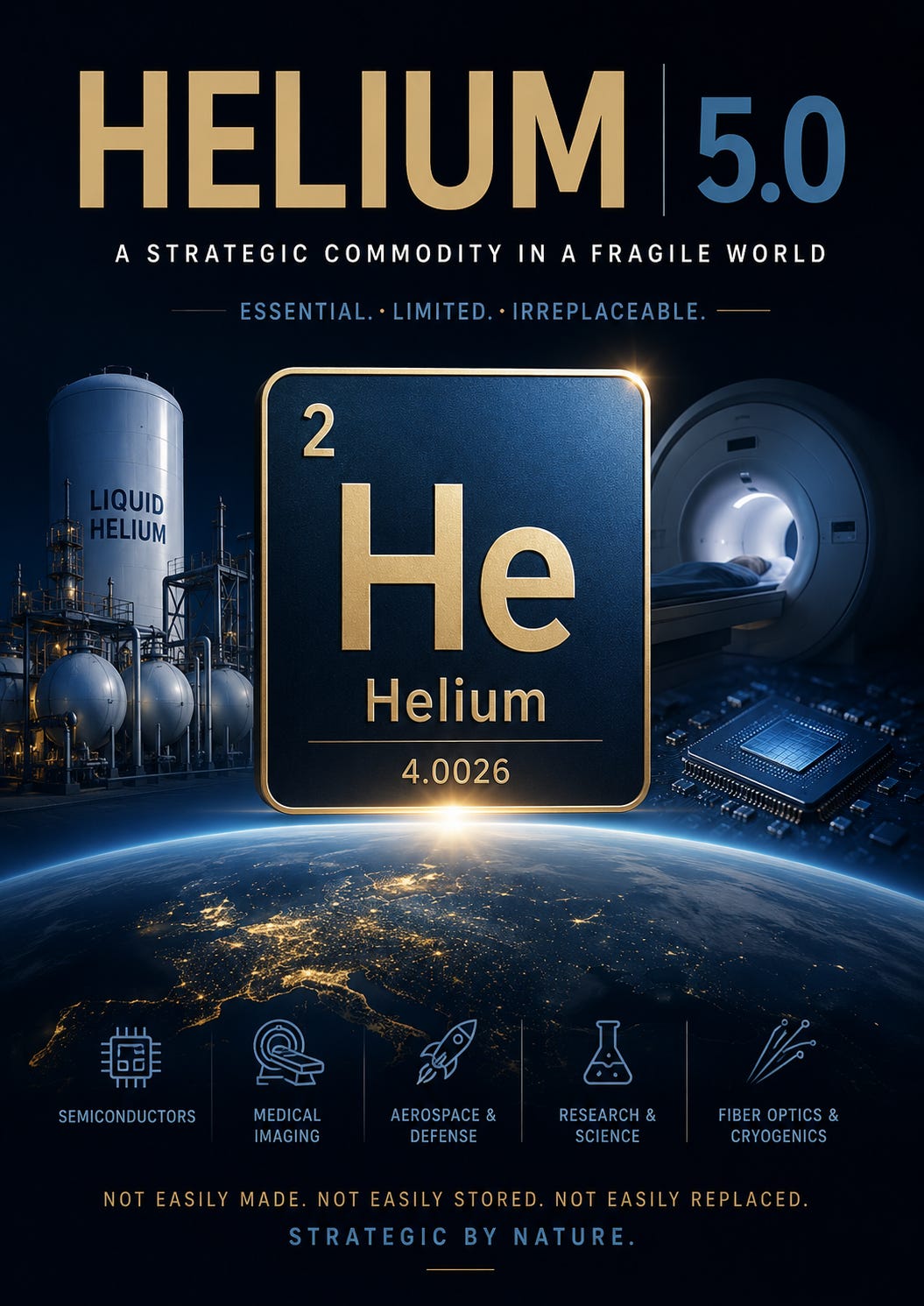
1. EXECUTIVE THESIS
The current tightening in helium should not be viewed as a single event. It is better understood as the latest phase in a series of disruptions that have exposed the same structural weakness repeatedly.
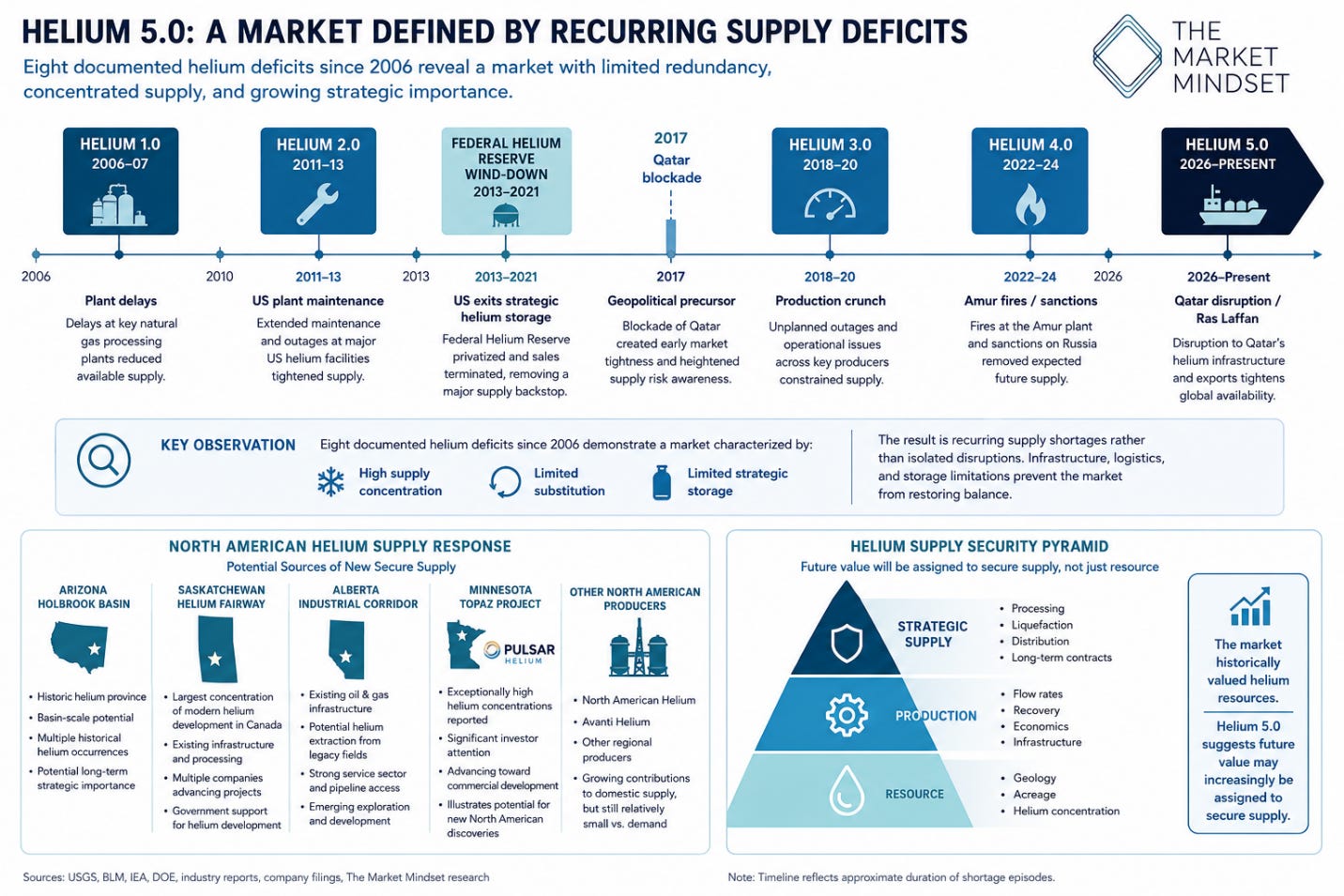
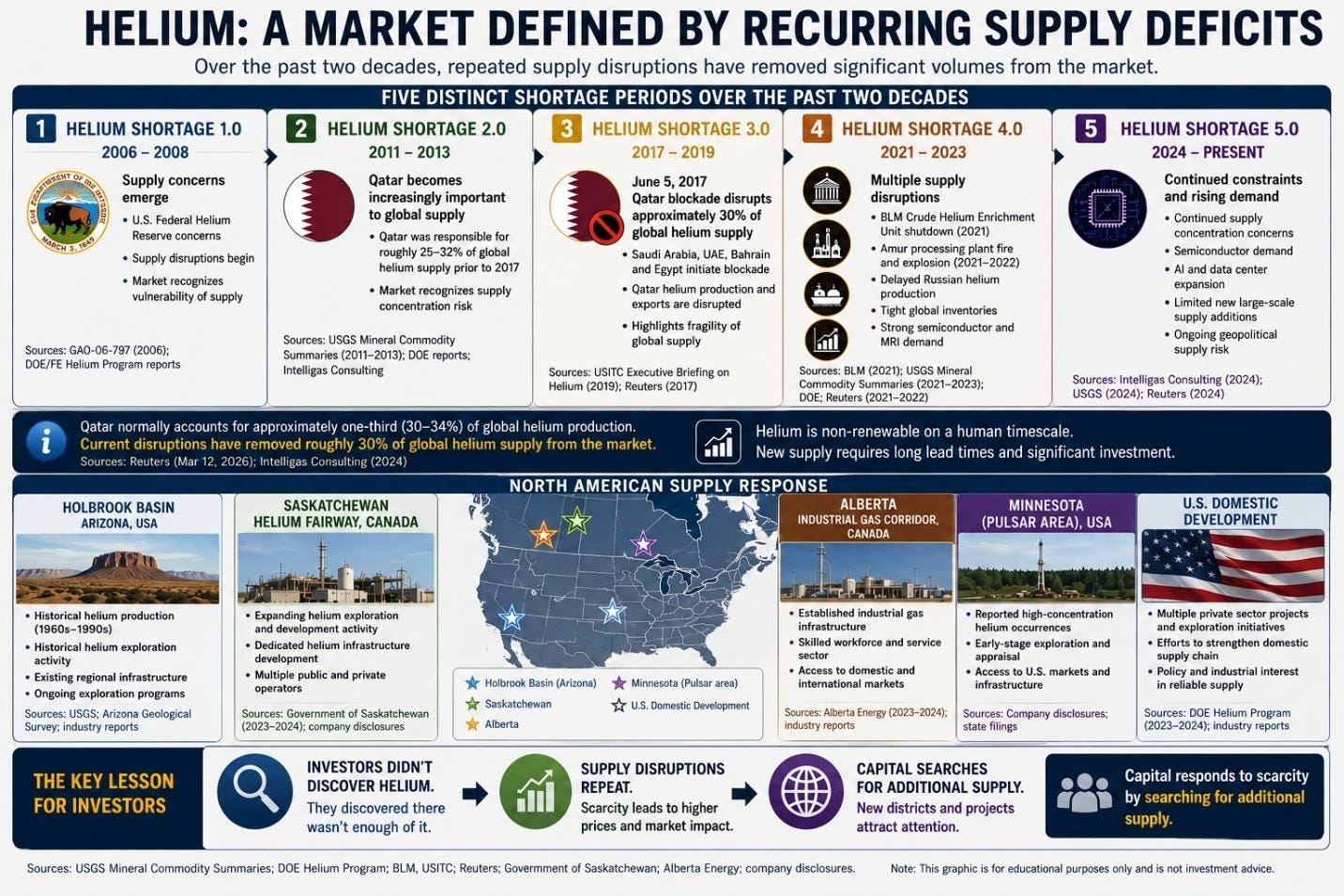
Over the past two decades, the helium market has moved through multiple shortage cycles, often described as “Helium 1.0” through “Helium 4.0.” Each phase was triggered by a different event, but the underlying issue has remained consistent: supply is concentrated, infrastructure is limited, and the system has very little redundancy.
Earlier cycles were tied to declining U.S. government reserves, outages at major production facilities, and delays in bringing new supply online. At the time, these were treated as temporary problems. The assumption was that the system would rebalance once capacity returned.
What has become clearer over time is that it doesn’t fully reset. Each disruption leaves the system with less flexibility than before.
Recent analysis by Joshua Santiago of Santiago & Company reinforces this conclusion. Santiago argues that the 2026 helium disruption is being misunderstood if it is framed only as a war story or temporary logistics problem. His core point is that helium combines high supply concentration, limited practical substitution, and limited stockpiling capability. That combination makes helium less like a normal commodity and more like a strategic utility system. When production, processing, logistics, or cryogenic transport are disrupted, the effects can last well beyond the event that triggered them.
The Amur gas processing plant in Russia was expected to be one of the most significant new sources of helium globally. The fires in October 2021 and January 2022 disrupted that expectation and made something fairly obvious: even large, well-funded supply additions are not guaranteed. That didn’t create an immediate shortage on its own, but it did remove confidence in future supply.
The current phase is being driven by disruption affecting Qatari infrastructure in 2026, along with increasing friction across key transport routes. Unlike the Russian disruption, which affected expected supply, this is interrupting material that is already part of the system today.
That distinction matters.
One removed future capacity. The other is hitting current flow.
In a market with limited storage, specialized processing requirements, and minimal large-scale recycling, those pressures don’t take long to show up. The system tightens quickly.
This is why the current phase is better described as “Helium 5.0.” Not because it is entirely new, but because it reflects a system that has taken repeated shocks and never rebuilt its margin for error.
2. THE ANTIMONY PLAYBOOK — HOW THE MARKET RESPONDED
Antimony did not re-rate because of a change in its physical properties or a sudden increase in production. The shift came when the structure of its market became visible. Supply was concentrated, access was politically sensitive, and demand was tied to defense and industrial systems.
This pattern is not unique.
Rare earth elements followed a similar path. In 2010, China’s export restrictions forced the issue into the open. Pricing moved quickly once supply risk became visible to global markets. Coverage expanded beyond technical circles, and governments responded by classifying rare earths as strategic inputs and funding alternative supply chains. The materials themselves hadn’t changed. The understanding of them had.
Antimony followed that same progression into 2025. As China’s dominance of supply and the fragility of Western sourcing became more widely covered, the material moved out of obscurity. It had already been listed as a U.S. critical mineral, but that classification only started to matter once supply risk entered the narrative investors were actually watching.
Government action reinforced the shift. Defense-linked funding and procurement programs, including support directed toward domestic supply chains and companies such as United States Antimony Corporation, made it clear this was no longer theoretical.
Once those pieces lined up — media recognition, policy alignment, and visible supply pressure — the market response followed. A small group of public companies moved quickly, not because new supply had been delivered, but because the importance of the material had been recognized.
That timing gap matters.
The market repriced the future well before it arrived.
Helium appears to be entering a similar recognition phase, but with a different physical structure. Antimony can be stockpiled. Helium cannot be stored at comparable scale without specialized infrastructure, ongoing cost, and loss over time. That makes helium potentially more sensitive to current disruptions because the market has fewer buffers.
3. HELIUM — SIMILAR CONDITIONS, DIFFERENT STRUCTURE
Helium shares several characteristics with antimony. Supply is concentrated among a limited number of regions, it plays a role in advanced industrial processes, and it is exposed to geopolitical disruption. That is enough to draw the comparison.
Where this diverges is in how the market actually functions.
Most commodities are stockpile markets. Gold, copper, nickel, rare earths and other critical minerals can be mined, refined, warehoused and stored for years. When supply is disrupted, consumers draw from inventories while prices adjust and new supply responds. The disruption affects future production, but it does not immediately remove material from the market.
Helium operates differently.
Helium is a flow market. Its value is determined by the continuous movement of purified product from producers to end users. Semiconductor manufacturers, MRI systems, aerospace programs, fiber optic producers and research facilities consume helium every day. The market depends on a constant chain of production, processing, purification, transportation and delivery.
This distinction is critical. A gold shortage is primarily an inventory problem. A helium shortage is primarily a flow problem.
When a gold mine shuts down, the world still has more than 200,000 tonnes of gold above ground. When a copper mine shuts down, warehouses and industrial inventories continue supplying the market. Helium has no equivalent strategic reserve. Inventories exist, but they are limited, expensive to maintain and incapable of supporting global demand for extended periods.
As Joshua Santiago of Santiago & Company argues, helium occupies a unique position because it combines three characteristics rarely found together: it is functionally irreplaceable in many critical applications, global supply is highly concentrated, and large-scale stockpiling is extremely limited. These characteristics cause helium to behave less like a traditional commodity and more like a strategic utility. As Santiago notes, “There is no tank farm. There is no cavern reserve.” Once a major source of supply is disrupted, the market cannot simply release years of stored inventory to stabilize supply.
This is why the current disruption matters. The issue is not merely the loss of production. The issue is the impairment of a system responsible for keeping helium flowing to critical industries. In a market with limited redundancy, limited storage capacity and concentrated supply, maintaining continuous delivery becomes more important than discovering additional resources.
For investors, this shifts the focus from geology to infrastructure. Resource size remains important, but during periods of supply stress the greatest value often lies with companies capable of producing, processing, purifying and delivering helium into the market. In Helium 5.0, reliability of supply may prove more valuable than the size of the resource itself.
It is extracted primarily as part of natural gas processing, then separated, purified, and transported through specialized infrastructure. Each step requires capital, time, and coordination. Storage exists, but it is limited and comes with loss over time. Recycling is not widely implemented at scale.
In effect, the system doesn’t have much slack.
Santiago’s framework sharpens this point. Helium occupies a different quadrant from most commodities because it combines three difficult characteristics at once: functional non-substitutability, severe supply concentration, and structural inability to be stockpiled at scale. In critical applications, there is often no practical replacement. In supply, a small number of regions and processing systems dominate global availability. In storage, inventories are constrained by cost, equipment, and unavoidable product loss.
In many commodity markets, inventories or alternative supply routes absorb short-term shocks. In helium, those buffers are thin. When supply is interrupted, the system adjusts quickly.
Helium as a Strategic Utility
Helium is increasingly behaving less like a conventional commodity and more like a utility-class dependency.
It has three defining characteristics:
Functional non-substitutability
There are few practical substitutes in critical applications such as cryogenics, semiconductor fabrication, MRI systems, aerospace, leak detection, quantum research, and advanced scientific instrumentation.Severe supply concentration
Global supply is concentrated in a small number of producing regions and processing systems. Disruptions in Qatar, the United States, or Russia can therefore affect the entire market.Limited strategic storage
Unlike metals or bulk commodities, helium cannot be stockpiled easily at large scale. Storage requires specialized systems and product losses occur over time.
Implication: helium shortages are not random anomalies. They are recurring symptoms of a market with limited redundancy.
4. THE CURRENT DISRUPTION — FROM TIGHT TO STRESSED
The present conditions are better understood as a sequence rather than a single event.
The first signal came from Russia, where expected future supply was affected by operational issues at a major processing facility. This didn’t remove existing production, but it did raise questions about how reliable future supply would be.
The second phase involves disruption to Qatari supply. Qatar represents a meaningful portion of global helium production, and recent geopolitical developments have affected both infrastructure and logistics. Processing capacity has been reduced, and export pathways have become less predictable.
Taken together, these developments compound. Future supply has been delayed, current supply has been reduced, and the system’s ability to reroute material has narrowed.
At that point, the adjustment is no longer marginal.
The system is operating under real pressure.
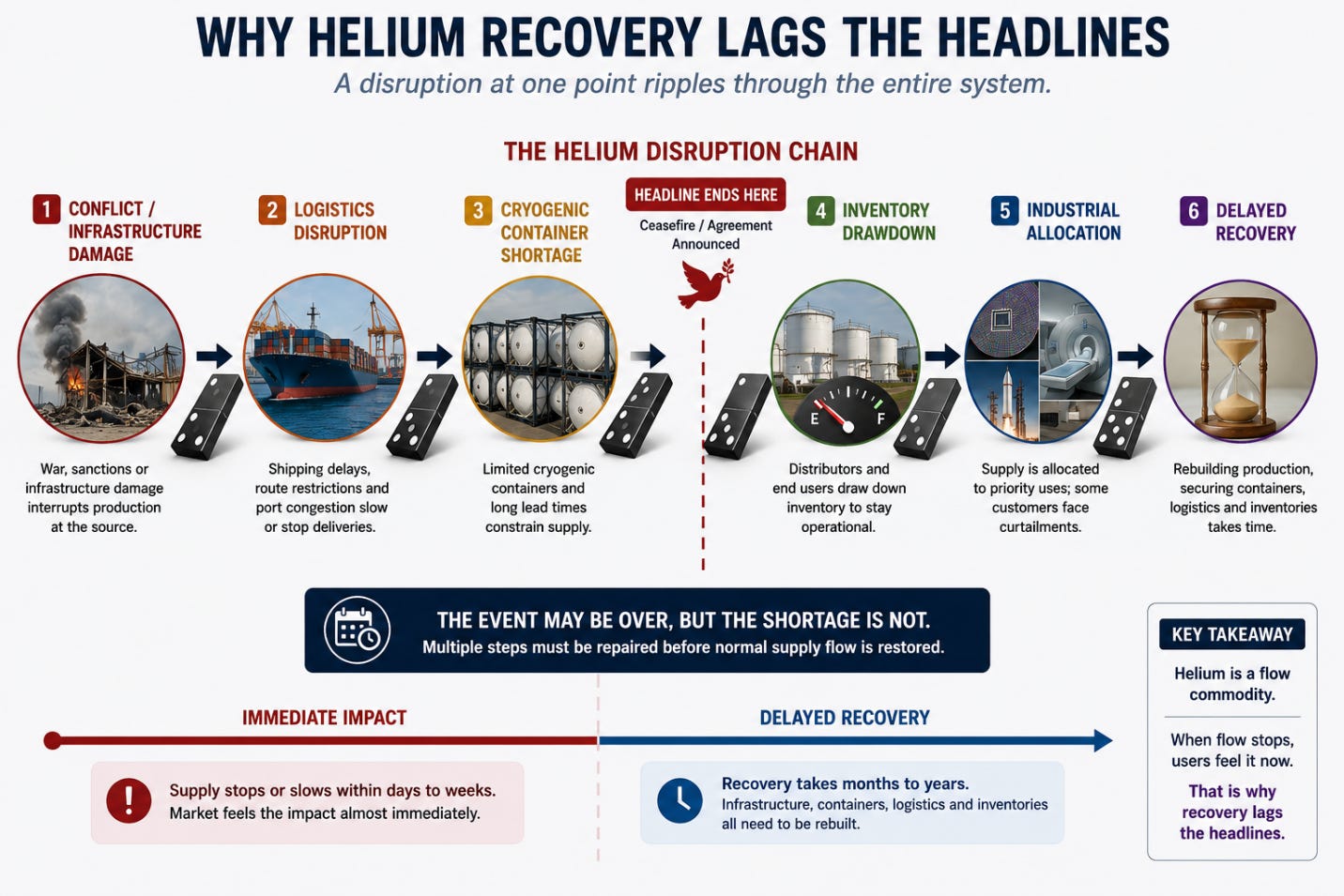
One of Santiago’s most important observations is that a ceasefire does not automatically restore helium supply. The political event may end before the physical supply chain has recovered. Infrastructure must be inspected, repaired, restarted, and requalified. Cryogenic containers must be repositioned. Export channels must normalize. Distributor inventories must be rebuilt. Product lost through boil-off cannot be recovered.
That means the market can remain tight after headlines improve. The ceasefire may change who is paying attention, but it does not immediately close the supply deficit.
This is especially important in helium because the system cannot be refilled quickly. New processing capacity, purification infrastructure, liquefaction, transportation equipment, customer qualification, and long-term contracts can require years. Even if the market recognizes the shortage immediately, the supply response may lag materially.
5. WHAT HELIUM ACTUALLY DOES — AND WHY IT NOW MATTERS
Helium demand is spread across industrial, scientific, and medical uses. Roughly twenty-two percent is tied to scientific and engineering applications. Semiconductor manufacturing accounts for approximately seventeen percent. Medical imaging systems represent another fifteen to seventeen percent. Aerospace and pressurization uses account for about nine percent, with the rest distributed across welding, leak detection, and other applications.
What stands out is not diversification, but dependence.
These are systems that don’t turn off easily.
The comparison to antimony becomes more precise when viewed through the semiconductor chain.
Antimony sits within materials used in industrial and defense systems. Helium sits earlier. It is part of the environment required to produce advanced semiconductors in the first place.
As demand increases for high-performance chips driven by companies such as NVIDIA and manufactured at scale by Taiwan Semiconductor Manufacturing Company, the requirements around process stability increase with it. That system is further defined by the equipment layer, where ASML sets the technical limits of production.
These companies illustrate the downstream systems whose performance depends on semiconductor fabrication, where helium is a real upstream process input.
The same logic applies to artificial intelligence and defense systems. Helium is not consumed directly in those applications in large volumes, but it is required earlier in the chain. It supports the fabrication of semiconductors and the operation of research and development environments that underpin advanced capability.
As AI-driven systems expand, including those associated with companies such as Palantir Technologies and Anduril Industries, demand for advanced compute increases. Traditional contractors such as Lockheed Martin integrate these capabilities into deployed systems.
Helium sits upstream of that entire stack.
It is not visible in the end product, but it is required for the process that enables it.
Santiago’s article makes this point more explicit. Helium is not simply an industrial gas. It is an upstream enabler of semiconductor manufacturing, advanced computing, aerospace systems, medical imaging, and defense capability. In semiconductor fabrication, helium supports cooling, leak detection, process stability, deposition environments, and heat management. As AI infrastructure expands, the demand for advanced chips increases, which in turn increases the strategic relevance of the inputs required to manufacture them.
The exposure of South Korea illustrates the issue. If major semiconductor producers source a large portion of their helium from a concentrated region, the problem is not simply price. Once distributor inventories are exhausted, the issue can become physical availability. At that point, procurement departments are no longer managing a normal input cost. They are managing a supply-security risk.
6. WHY THE RESPONSE PROFILE DIFFERS FROM ANTIMONY
Helium behaves differently when the system tightens.
Substitution is limited. In cryogenic applications, there isn’t a practical alternative.
Recycling is minimal at scale. Once used, helium is often lost from the system.
Storage exists, but it doesn’t meaningfully absorb a disruption of this size.
Most importantly, supply is governed by processing and delivery capacity rather than the resource itself.
The issue is not finding helium.
It is moving it.
This is the central infrastructure point. Higher prices can incentivize new supply, but they cannot instantly create separation plants, purification systems, liquefaction, transport fleets, cryogenic containers, or qualified customers. Helium supply is not only a geological question. It is a production, processing, logistics, and allocation question.
This distinction should shape how investors evaluate the entire sector. The relevant question is not simply which company has helium-bearing acreage. The better question is which company can realistically move helium into the market within the next several years.
7. THIS IS THE SAME TRADE — BUT TIGHTER
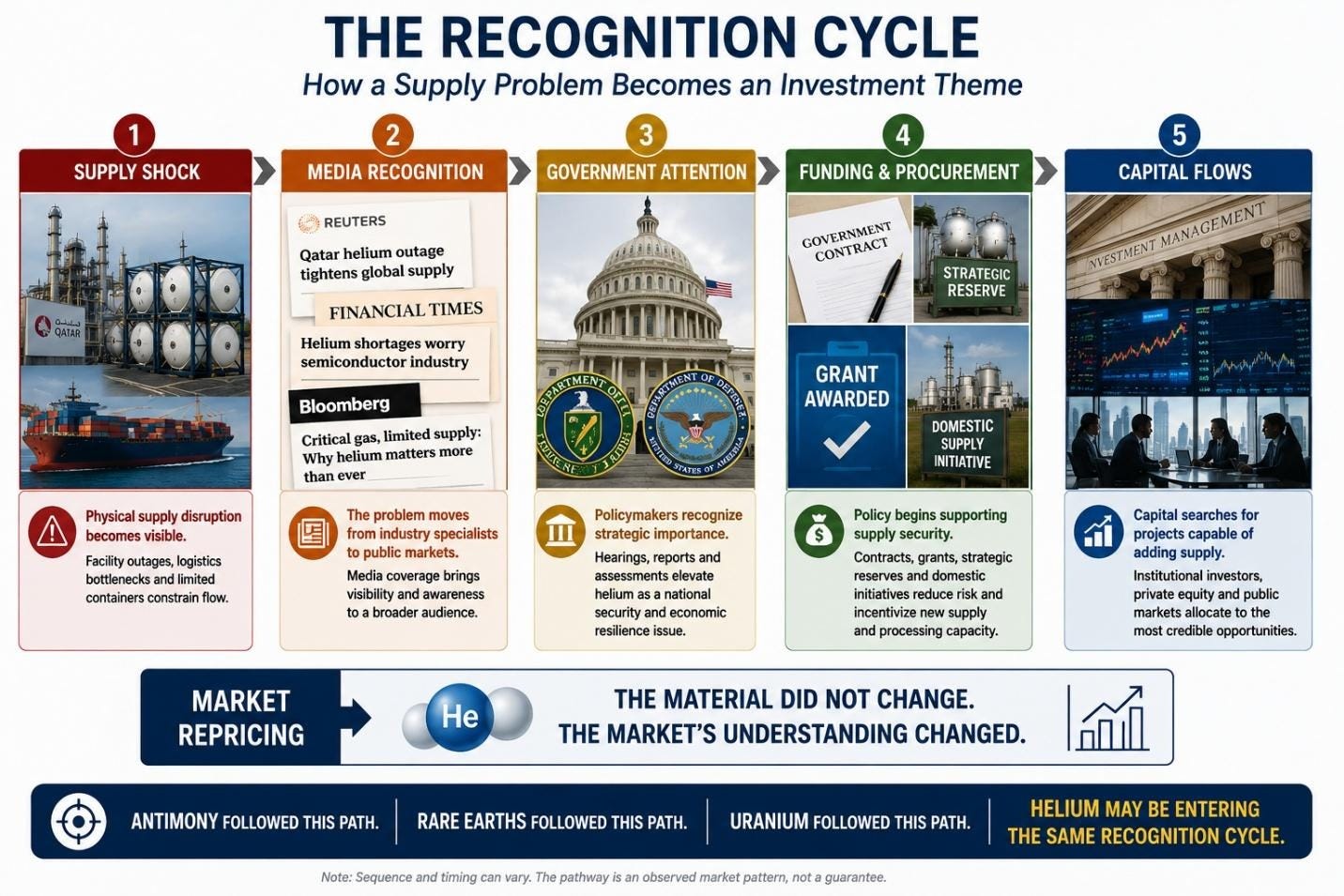
The sequence seen in antimony provides a useful reference. Supply concentration became visible, strategic importance was recognized, government involvement followed, and capital moved into the sector.
Helium is now moving through a similar sequence. Supply disruption is visible. Its role in critical systems is already understood. Pricing and availability are starting to reflect that.
The difference is timing.
Antimony allowed the market to price future supply. Helium is already affecting current delivery. The system has very little flexibility left in the near term.
That makes Helium 5.0 potentially more urgent than a standard critical-minerals repricing. In many materials, the market can speculate years ahead of a deficit. In helium, the deficit can show up in allocation, delivery schedules, and end-user availability before new projects can respond
8. MARKET STRUCTURE — WHERE CAPITAL FLOWS
When supply tightens visibly, capital moves in stages.
Large industrial gas companies such as Linde plc, Air Liquide, and Air Products and Chemicals sit at the center of the system. They control processing, logistics, and customer relationships.
They are not discovering helium. They are structuring, processing, and controlling how it enters the market. New supply typically comes through long-term offtake agreements, joint ventures with gas producers, and investment in processing infrastructure tied to upstream production.
That model works when supply is expanding. It becomes less flexible when large portions of global production are disrupted and new upstream sources are limited.
Beyond that, attention shifts toward assets that can realistically bring supply online in shorter timeframes.
There is a narrower part of the market that sits between large industrial gas operators and long-dated exploration — companies that have already demonstrated some combination of resource quality, processing capability, and actual delivery into the market.
This segment matters because it is one of the few places where supply could realistically be expanded in the near term. Even then, it is important to be clear: even viewed collectively, these companies are not in a position to replace a meaningful portion of the supply currently at risk. The scale of disruption is measured in billions of cubic feet annually, while most emerging North American supply sources operate at a fraction of that level.
This is not a shortfall that can be resolved by a handful of smaller operators. At best, they contribute incrementally, and only with additional capital and execution.
The question is not who solves the shortage.
It is who is closest to participating in the response.
The Santiago framework strengthens this section because it shifts the investor lens away from resource ownership alone. In a strategic utility market, the key differentiator may be access to the system: production, processing, purification, logistics, distribution, contract architecture, and recovery systems. A helium resource that cannot be processed or delivered is not equivalent to secure helium supply.
This creates an important framework for evaluating all helium projects:
Key positives to evaluate
Projects become more strategically relevant if they have:
demonstrated production capability;
existing or near-term processing infrastructure;
purification capability;
access to compression, transport, or liquefaction systems;
customer relationships or offtake discussions;
commercial delivery history;
strategic location near North American industrial demand;
scalable geology supported by technical data;
ability to add supply within a realistic timeframe.
Key concerns to evaluate
Projects remain higher risk if they have:
helium shows but no production;
resource potential without infrastructure;
dependence on future financing;
unclear processing route;
weak flow rates or uncertain deliverability;
permitting delays;
no customer qualification;
no logistics solution;
no evidence of repeatable commercial sales.
This does not mean exploration is irrelevant. It means the market may begin assigning higher value to proximity to revenue, infrastructure control, and supply-chain participation. In a shortage, geology matters. Deliverability matters more.

Among public names, Desert Mountain Energy stands out within that context. Over the past five years, the company’s work in Arizona established strong helium concentrations, with early wells reporting grades above 4% and up to 7% helium in raw gas testing — levels that sit well above typical economic thresholds in the sector.
More importantly, the company has already demonstrated elements of a functioning system. It moved and installed processing infrastructure in New Mexico, brought commercial helium production online in 2024, and has delivered product to end-users. That does not make it a large-scale solution, but it does place it in a different category from companies that still need to prove either plant capability or commercial delivery.
A further layer to that positioning is the company’s exposure to the Holbrook Basin in Arizona. This is not a new, untested concept. The basin has a long history of drilling and data collection, with documented helium occurrences across multiple wells. While it does not have a defined resource in the conventional reporting sense, the available data points toward a potentially basin-scale helium system that has not been fully developed.
That distinction matters. It introduces the possibility of scale alongside existing proof of production and processing.
Any attempt to advance that potential would require capital, additional drilling, and further technical validation. However, the combination of historical data, demonstrated helium concentrations, and existing infrastructure places it in a different category from early-stage exploration.
That positioning becomes more relevant as market conditions tighten. In a looser market, investors often prioritized fixed offtake agreements and defined commercial pathways. In a tighter market, optionality carries more weight. A company with demonstrated infrastructure and uncommitted potential production has more flexibility than one that has already locked in volumes under earlier-cycle terms.
That is not a valuation claim. It reflects how priorities shift when availability begins to matter more than long-term contracting.
Other companies sit further back along that curve.

Pulsar Helium has reported very high helium concentrations and improving flow test results at its Topaz project. Those results are notable. At the same time, the project remains in the development stage and would require processing infrastructure and capital before contributing to actual supply.
Privately, operators such as North American Helium and Avanti Helium are already producing or advancing toward production with institutional backing and integrated infrastructure buildout. These companies are contributing to North American supply growth, but are not directly accessible from a public market perspective.
Taken together, the picture is relatively clear.
There are very few operators that combine resource quality, processing capability, and demonstrated delivery. Most are missing at least one of those elements.
All would require additional capital to scale. None are positioned to resolve the current imbalance on their own.
From a capital allocation perspective, the differentiation comes down to proximity to revenue. Based on known data, companies that have already demonstrated production, processing, and delivery — even at smaller scale — are closer to that point than those still proving the resource or building infrastructure.
That is not speculation. It is a function of where each sits along the development curve.
9. GOVERNMENT RESPONSE — THE NEXT PHASE
The progression seen in antimony suggests what may follow.
Awareness leads to policy attention. Policy attention leads to funding and procurement support.
Helium already sits inside systems that tend to draw that attention — semiconductors, aerospace, and medical infrastructure.
The policy response hasn’t fully caught up yet.
Santiago’s analysis reinforces why that may change. Governments do not need helium because it is interesting as an industrial gas. They need the systems helium supports: semiconductor fabrication, artificial intelligence infrastructure, defense manufacturing, aerospace, medical imaging, quantum research, and advanced scientific capability.
If helium is increasingly understood as a strategic utility, the government response could eventually shift from observation to intervention. That could include support for domestic production, processing infrastructure, strategic reserves, recycling systems, procurement agreements, financing support, or industrial-gas partnerships. This does not mean every helium company benefits. It means the market may begin to separate companies that can contribute to secure supply from those that merely hold prospective acreage.
10. SYSTEM-LEVEL OBSERVATION
The limitation in helium is not geological.
The resource exists.
The issue is the system.
Extraction, processing, and delivery require infrastructure that cannot be scaled quickly. Storage and recycling do not provide enough flexibility to absorb large disruptions.
Supply is governed by what the system can deliver.
Viewed through Santiago’s framework, helium is increasingly an infrastructure challenge rather than a resource challenge. The core constraint is not whether helium exists globally, but whether enough of it can be produced, purified, transported, allocated, and delivered into critical markets when the system is under stress.
This is why the 2026 disruption matters. It is not just a temporary supply shock. It is a stress test of a market that has repeatedly shown it lacks spare capacity.
11. FINAL TAKE
The helium market is moving from balance into a tightening supply environment.
The combination of delayed future supply and reduced current flow has left the system with very little room to adjust at a time when demand remains steady across critical sectors.
The comparison to antimony is useful, but incomplete. Antimony showed how quickly a market can reprice once importance is recognized. Helium is already affecting availability.
The most important implication for investors may be that future winners in the helium sector are unlikely to be determined solely by resource ownership. As supply security becomes more important, markets may place greater emphasis on production capability, processing infrastructure, logistics, delivery systems, and the ability to contribute secure supply to a market with limited redundancy.
The key positives and concerns now apply across the entire sector. Positives include real production, processing capability, delivery history, infrastructure access, strategic location, and scalability. Concerns include unproven economics, lack of processing, dependence on future financing, permitting risk, weak logistics, and absence of commercial delivery.
The question now is whether the system can keep up from here.
Helium 5.0 is not only about price.
It is about whether a strategic input can be reliably supplied to the industries that increasingly depend on it.