

Decade Resources Is Beginning to Show the Shape of Bonaparte
Four weeks after our interview with Decade president Ed Kruchkowski, Bonaparte has moved beyond one encouraging deep hole. Porphyry geology is now repeating across the target. Grade remains the decisive test.
Andrew O’Donnell | The Market Mindset
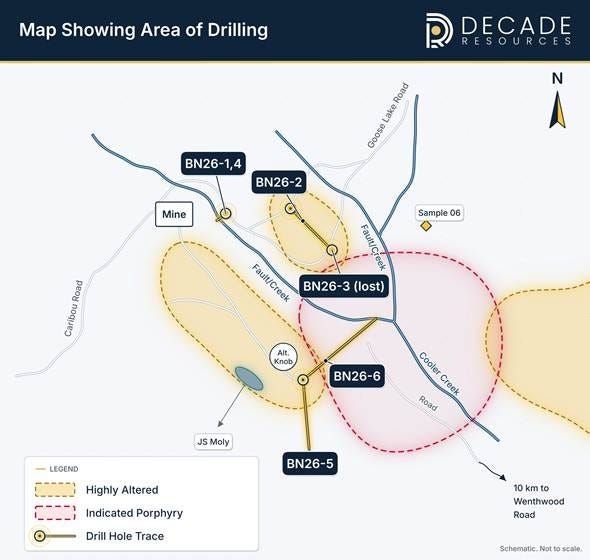
Decade’s schematic interpretation of the Bonaparte drilling area and altered porphyry footprint along Cooler Creek. Source: Decade Resources, October 8, 2026. Not to scale.
Four weeks ago, I sat down with Decade Resources president Ed Kruchkowski to discuss the first deep test of the Bonaparte copper-gold thesis north of Kamloops.
At that point, the attraction was not the visual copper by itself. It was the sequence of evidence. The B.C. Geological Survey had previously proposed that Bonaparte’s historical high-grade gold veins could represent the upper expression of a buried gold-copper porphyry system. A large chargeability anomaly gave Decade something tangible to test. DDH-BN-1 then passed through propylitic alteration, into potassic alteration, and finally into feldspar porphyry carrying chalcopyrite and occasional molybdenite.
The first hole did not establish grade, size or economics. It did something more basic: it showed that the geological model had survived its first direct drill test.
The thesis is becoming repeatable
Today’s update advances that story. Decade has completed five holes totalling approximately 2,000 metres, with a sixth underway. Every completed hole that reached bedrock intersected porphyry dykes within highly altered rock. DDH-BN-3 was lost in overburden and will be redrilled, so it tells us nothing geologically yet. The meaningful point is that DDH-BN-2 and DDH-BN-5 both intersected porphyry dykes despite being collared 1.2 kilometres apart.
That does not prove 1.2 kilometres of continuous mineralization. A porphyry dyke is evidence of the intrusive system, not proof of ore. But it materially reduces the risk that DDH-BN-1 was an isolated geological curiosity. Surface mapping and drilling now support Decade’s interpretation of a heavily altered porphyry environment extending more than two kilometres across the Cooler Creek valley.
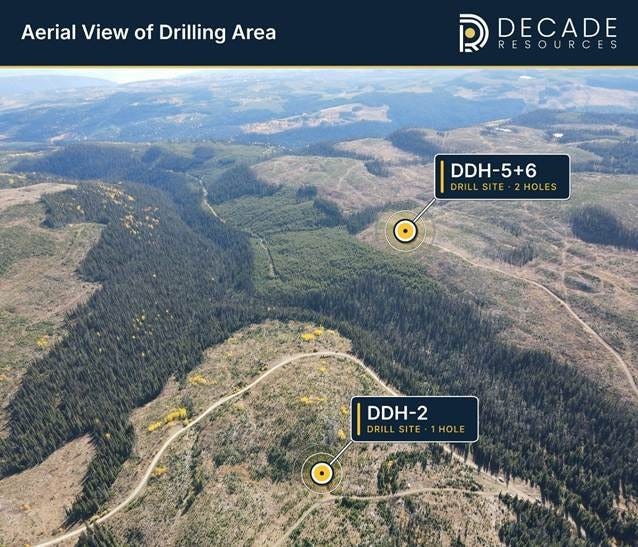
Aerial view of the Bonaparte drill area. DDH-BN-2 and DDH-BN-5 were collared approximately 1.2 kilometres apart and both encountered porphyry dykes. Source: Decade Resources.
DDH BN 6 is now the hole to watch
The most consequential part of the release is DDH-BN-6. Decade reports that the hole is cutting strongly potassic-altered rock containing chalcopyrite and hydrothermal breccia. Those three features matter together.
Potassic alteration commonly develops closer to the central parts of a porphyry system. Chalcopyrite shows that copper-bearing fluids were active. Hydrothermal breccia records the movement of hot, pressurized fluids capable of breaking and recementing the host rock. Decade believes that combination may place DDH-BN-6 closer to a porphyry centre.
That is a geological vector, not an assay result. The centre of an alteration system is not automatically the centre of economic mineralization. What DDH-BN-6 may provide is a better sense of direction: where the intrusive system becomes stronger, where the fluid activity intensifies and where subsequent holes should be aimed.
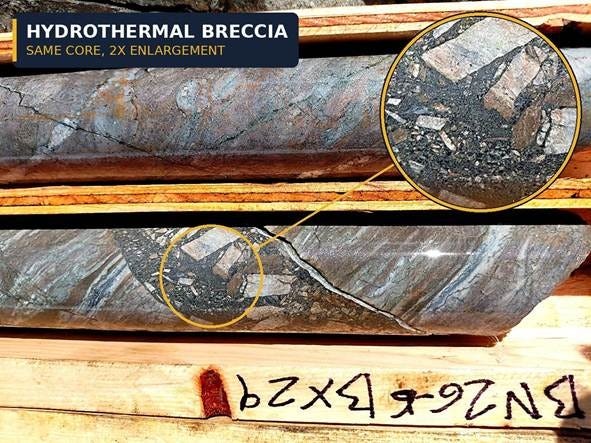
Strong potassic alteration and hydrothermal breccia reported at approximately 150 metres in DDH-BN-6. Visual geology cannot determine grade. Source: Decade Resources.
Large system or large alteration footprint
That is now the question. Decade has a historical IP anomaly measuring approximately three kilometres by four kilometres, porphyry dykes in holes spread across the target, and altered rocks mapped over a broad area. The Discovery Area may also reflect a second porphyry event associated with a north-south-trending quartz-diorite porphyry. If that interpretation holds, Bonaparte may be more complicated—and potentially more extensive—than a single intrusion beneath the old gold workings.
Still, a large altered system is not the same as a large mineralized deposit. Pyrite and alteration can generate impressive geophysical and geological footprints without producing economic copper grades. The phrase ‘porphyry in every hole’ establishes geological repetition. It does not establish metal content.
The evidence ladder is working
· The model came first. Historical gold veins, intrusive geology and a large IP response supported a buried-porphyry thesis.
· The first test worked geologically. DDH-BN-1 encountered the predicted alteration sequence and mineralized feldspar porphyry.
· The geology is repeating. Porphyry dykes have now been encountered in every completed hole that reached bedrock, including holes 1.2 kilometres apart.
· A possible vector is emerging. Strong potassic alteration, chalcopyrite and hydrothermal breccia in DDH-BN-6 may point toward a porphyry centre.
· The economic test remains open. Assays must establish grade, width and metal distribution; further drilling must establish continuity and geometry.
Now the assays have to carry the story
This is the part of exploration where excitement and discipline have to coexist. The company has methodically tested a pre-existing thesis, encountered the expected geological architecture and then repeated porphyry-related geology across a much broader area. That is real progress.
The next advancement cannot come from another description of alteration alone. Investors need to see whether copper, molybdenum and gold occur across meaningful widths, whether grades strengthen toward the proposed centre, and whether mineralization can be correlated between holes. More than 1,300 soil samples may help refine the broader model, including the eastern area approximately five kilometres from the drilling, but they will not replace the drill assays.
Four weeks ago, Bonaparte had produced one very good geological result. Today, it is beginning to show the shape of a system. That is a meaningful improvement in the thesis. Whether it becomes a meaningful copper-gold discovery will be decided by grade and continuity—not by the size of the alteration halo or the language of the headline.
Disclosure This article is based on public company disclosure and The Market Mindset’s prior interview with management. Visual observations are preliminary and cannot establish grade or economic viability. This is not investment advice.